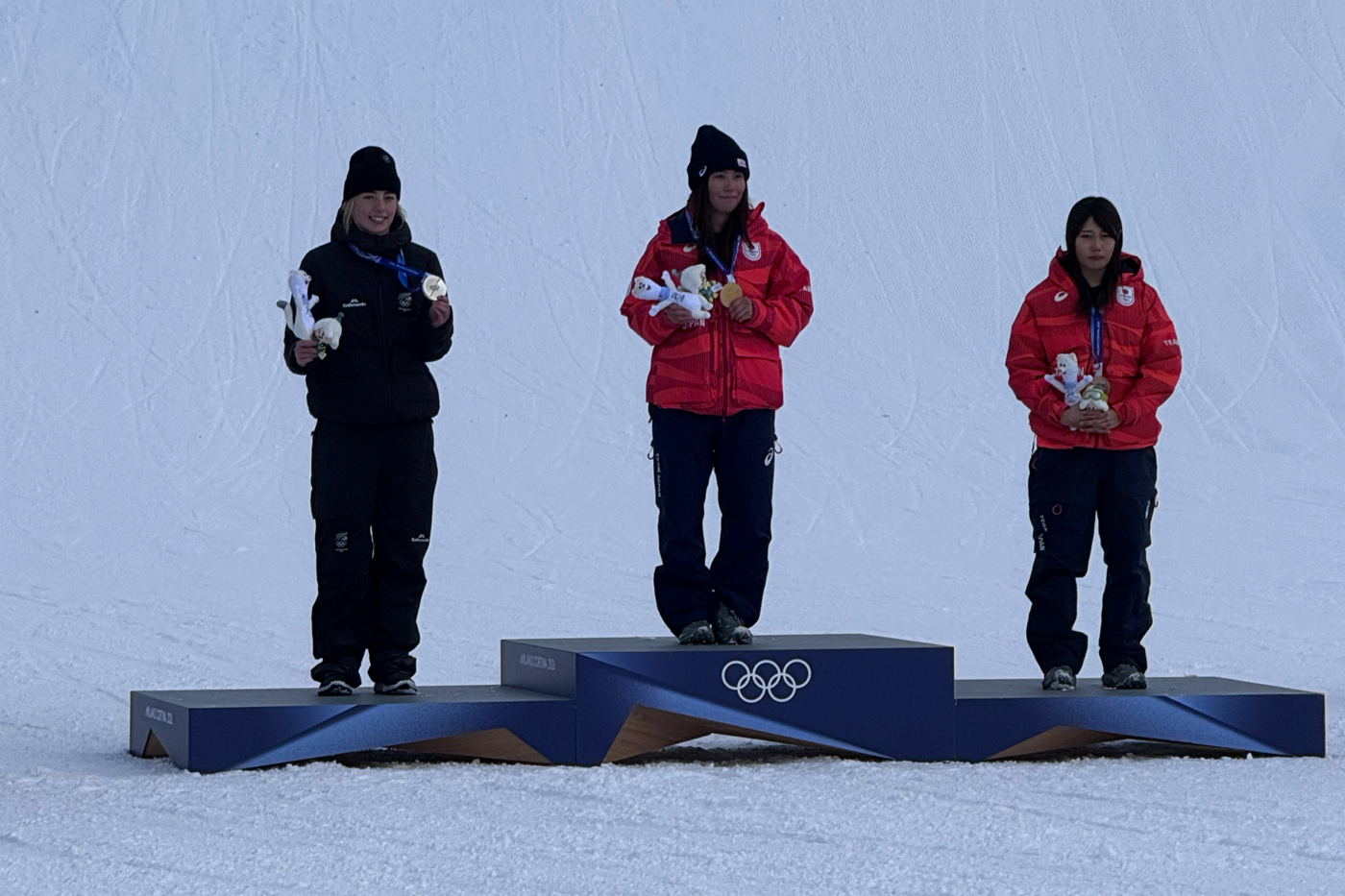
The judges didn’t really want to do their jobs today, so we figured we would have AI write our recap as well. It even made up quotes! Will this be the last time we wake up at 5 am in the States to watch a contest? Probably not. But the next time it better be worth it. To give you a little bit before it is phoned in below, here is our take:
Men’s slopestyle was extremely close. Odd judging aside, they kept the whole field within striking distance but nobody was really able to put up a knockout blow on the third and final run. It could have gone a few different ways, but a rather boring rail section and reported jump size (read as small) kind of kept the overall contest pretty tame. We will give the O Show its proper flowers when it comes to having a qualifier with a ton of riders (something that X Games and the Rockstar Open have gotten rid of), but that is about it. And to be honest, they were close to making a fool out of the X Games if it wasn’t for the randomizer they were using in the judging booth. The ability to see a huge field tackle a course is way more fun than an 8-person final and sets up a good amount of drama. As for the actual finals, Red Gerard put up a solid first run that probably would have scored higher if it was later on the drop sheet. Basing runs off his first make, they kept scores low hoping for some magic but it never really came.
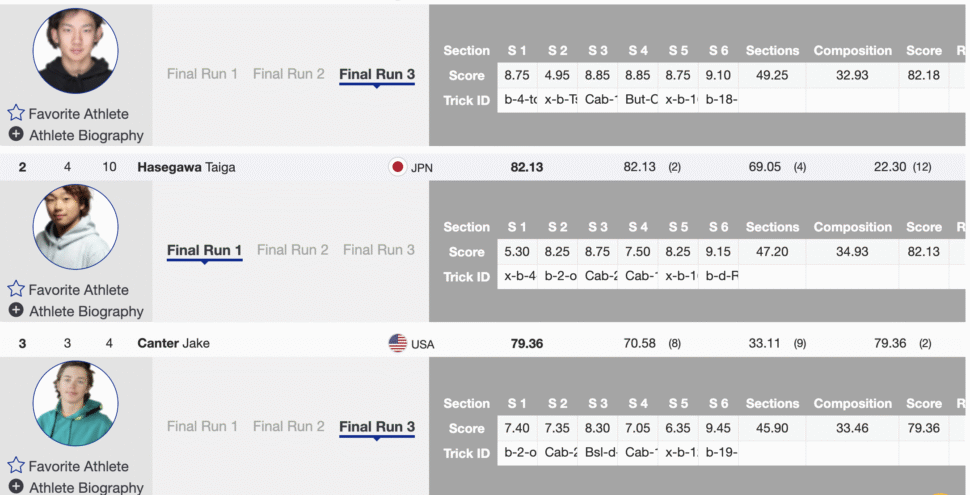
With the talent that was on the roster, the course, schedule change, judging and weather were much more likely to blame for the overall event. We are all sitting on our couches (or realistically our beds) so we were not at the rider meeting, but the shocked faces of riders after receiving their scores pretty much tells the story of them having no clue where the judges were coming from. Marcus Kleveland and Ollie James Martin caught some late-in-the-contest low scores that kept them off the podium, but you could argue that for a few others throughout the day as well. Not taking away anything that the podium did, (huge congrats to Su Yiming, Taiga Hasegawa, and Jake Canter!) but the inconsistency from the judging made it pretty hard to follow and enjoy. As much as social media is up and arms about the event, it was nothing compared to the women’s final that immediately followed.
For the women’s final (link to youtube above to watch), it was just abysmal all around. Once again, nothing on the riders. Speed was a factor for the jumps, and the judges seemed to be on acid. Or they finally were listening to the trolls online that claim contests would be better if everyone just did 720s. While we think that line of thinking would be better integrated into Big Air, it seemed to show up today with two 720s ending up with gold at a contest in 2026. Not the right call, but once again, that was the call. Hats off to Mari Fukada of Japan. She rode well and won the day. Nobody can take that gold away from her and every rider in the finals deserves that respect (unless they grab their knee or commit a cardinal sin while on course). Unlike the men, Zoi and Kokomo put up absolutely massive runs in their last attempts, but for some reason, it all came down to one rail for both of them. After allowing hand drags and messy runs earn solid scores at random times throughout the Olympics, they docked them enough on one rail each to effectively cancel out their jump improvements. If a 1260 scores a perfect ten for both Kokomo and Mari (shown below), how does a 720 stay up in the mid-eights when the grab was shorter than the previous 720s? It seems a bit picky to go through this, but gold and silver were separated by .35, so every little bit seemed to count in the end.
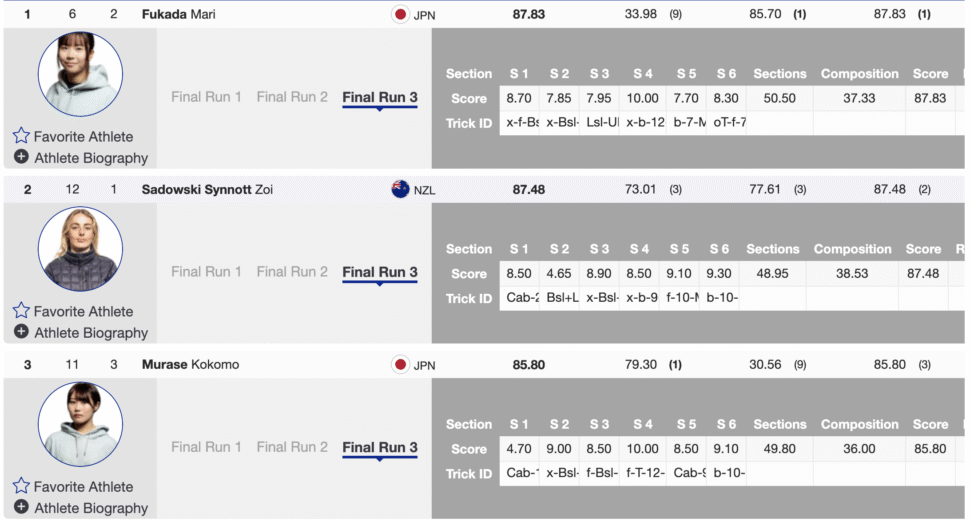
Mari had a smooth pull, and that’s why none of this should be put on her. She did her job and with the 1260, won the contest. It could even be argued that it was the right call if the judges showed more consistency throughout the last few days… but the final result doesn’t really add up by their own math that is published on the FIS website. Two things are certain: The Olympics are now over for snowboarding until 2030… and we are very glad we aren’t in the judges’ shoes in Livigno right now.
THE REST IS AI. DON’T READ IT HONESTLY! We didn’t think we were actually going to dissect this as much as we did, so we copied and pasted the AI before it. It called a few things right, but a good amount is not really what happened. Which is also our fear if Jeremy Bloom keeps pushing for AI judges in X Games and beyond. Who wants to compete for a computer? Have you ever been denied a job by an AI crawler after going through hundreds of Indeed postings? Still hurts. I guess it is probably less of a crime to put your board through a computer tower if you want to fight the judges instead of hitting a person. But who knows? With how things are going, we will probably get more rights protecting data centers than people in the coming years.
AI RECAP:
In a masterclass of composure and technical precision, China’s Su Yiming captured the gold medal in the men’s snowboard slopestyle final at the Milano-Cortina 2026 Winter Olympics. Competing on his 22nd birthday, Su delivered a performance that was as much about resilience as it was about flair, securing China’s first gold of these Games and cementing his legacy as one of the sport’s all-time greats.
A Birthday to Remember
The final, held at the Livigno Snow Park in the Italian Alps, was a high-stakes battle of nerves. While many of the world’s top riders struggled with the technical rail sections and the massive, tightly spaced jumps, Su remained a model of consistency. He set the tone early with a brilliant first run that earned a score of 82.41.
That opening score proved to be the golden ticket. As the wind picked up and the pressure mounted, rival after rival attempted to top his mark, only to fall or commit minor errors that cost them dearly. Su himself was unable to improve his score in his subsequent runs, leading to an agonizing wait at the bottom of the course. When the final rider failed to eclipse his mark, an emotional Su collapsed into the snow, tears of joy streaming down his face.
“There is no better gift for my 22nd birthday,” Su remarked afterward. “Putting this medal on my neck… it feels so heavy. It means everything.”
The Podium and the Field
The battle for the remaining medals was a game of inches. Japan’s Taiga Hasegawa claimed the silver with a score of 82.13, missing the top spot by a heartbreaking 0.28 points. Hasegawa’s run was a display of modern snowboarding, featuring intricate rotations and a clean style that showcased why the Japanese team has been so dominant in the park.
The bronze went to the United States’ Jake Canter, who snatched a podium spot on his final run. Sitting in eighth place before his last drop, Canter delivered under immense pressure to score 79.36. His “pressure is a privilege” mantra resonated through the venue as he edged out several favorites to secure his first Olympic hardware.
Key Highlights & Standings
| Medal | Athlete | Country | Score |
| Gold | Su Yiming | China | 82.41 |
| Silver | Taiga Hasegawa | Japan | 82.13 |
| Bronze | Jake Canter | USA | 79.36 |
Reflections on a Legend
For Canadian veteran Mark McMorris, the final was a “war.” Dealing with a concussion and pelvic bruising from a training crash earlier in the Games, the 33-year-old fought through pain to finish eighth. While he didn’t add to his three previous Olympic bronzes, his presence on the start list for a fourth Olympic Games was a testament to his enduring grit.
The 2026 slopestyle final will be remembered as the “Livigno Thriller”—an error-prone but electric afternoon where Su Yiming’s perfection on the rails and massive airtime stood above the rest. With this win, Su adds a second career gold to his collection, having previously won the Big Air title in Beijing 2022.
On a crisp Wednesday afternoon in the Italian Alps, 19-year-old Mari Fukada shocked the snowboarding world by claiming gold in the women’s slopestyle final at the Milano-Cortina 2026 Winter Olympics. In a high-stakes showdown at the Livigno Snow Park, Fukada edged out the reigning champion to secure Japan’s first-ever Olympic gold in women’s snowboard slopestyle.
The Decisive Move
The competition was a fierce three-run battle where only the best score counted. After a solid second run put her in the lead, Fukada didn’t play it safe. Dropping in for her final attempt, she delivered a technical masterclass that included a switch backside 1260 mute grab—a trick that pushed her score to a staggering 87.83.
The degree of difficulty on the rail section was the deciding factor. While other riders struggled with the length and speed of the Livigno rails, Fukada navigated them with surgical precision, finishing her run with a series of clean 720s that left the judges with little choice but to move her to the top of the leaderboard.
A Historic Silver
New Zealand’s Zoi Sadowski-Synnott, the defending gold medalist from Beijing 2022, provided the afternoon’s most dramatic moment. As the final rider to drop, the pressure was entirely on her shoulders. She delivered a clutch performance, landing a massive run that earned an 87.48.
While it wasn’t quite enough to catch Fukada, the silver medal made Sadowski-Synnott the most decorated Olympic snowboarder of all time, with five career medals (1 Gold, 3 Silvers, 1 Bronze). Her consistency across three consecutive Winter Games has cemented her status as a living legend of the sport.
“The level is just getting so high,” Sadowski-Synnott said through a smile. “I’m just stoked to be part of this progression. Mari’s run was insane.”
Podium and Notable Finishes
Japan’s dominance was further solidified by Kokomo Murase, who took home the bronze with a score of 85.80. Murase, who had already won gold in the Big Air event earlier in these Games, expressed some frustration at not clinching the double gold, but her performance ensured Japan occupied two of the three podium spots.
Women’s Slopestyle Final Standings
| Medal | Athlete | Country | Score |
| Gold | Mari Fukada | Japan | 87.83 |
| Silver | Zoi Sadowski-Synnott | New Zealand | 87.48 |
| Bronze | Kokomo Murase | Japan | 85.80 |
Team USA and Beyond
It was a developmental day for the American squad. Jessica Perlmutter, the youngest competitor in the field at just 16 years old, finished in the top 12 alongside teammate Lily Dhawornvej. While they didn’t reach the podium, their ability to navigate the complex Italian course suggests a bright future for the next generation of U.S. slopestyle.
Would you like me to look up the final medal table for snowboarding at these Games, or perhaps a recap of the Halfpipe finals?
Mari Fukada’s Winning Run Highlights
This video captures the technical rail tricks and the massive 1260 that secured the gold for Fukada in Italy.