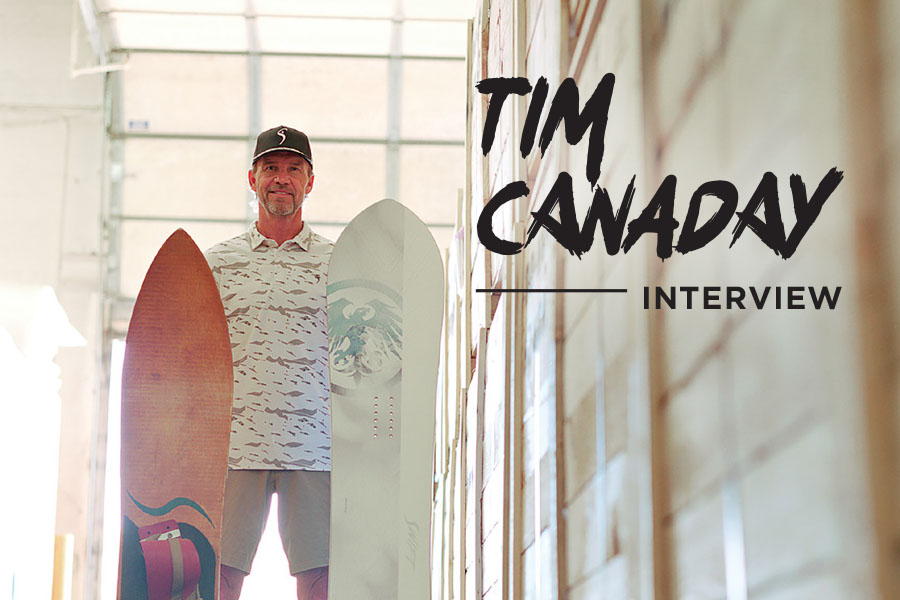
As Never Summer enters its 35th year making snowboards in the heart of Colorado, co-founder Tim Canaday continues finding new ways to develop snowboards for global usage. Pressing his first board in the early 1980’s with his brother and business partner Tracey, Tim has designed and tested thousands of snowboards in his 45 year career. The best part? He and his team keep developing trendsetting profiles, discovering new technologies, and pushing the limits of what their already high performance snowboards can do.
Mike Basher: When was the first time you snowboarded, and what board was it on?
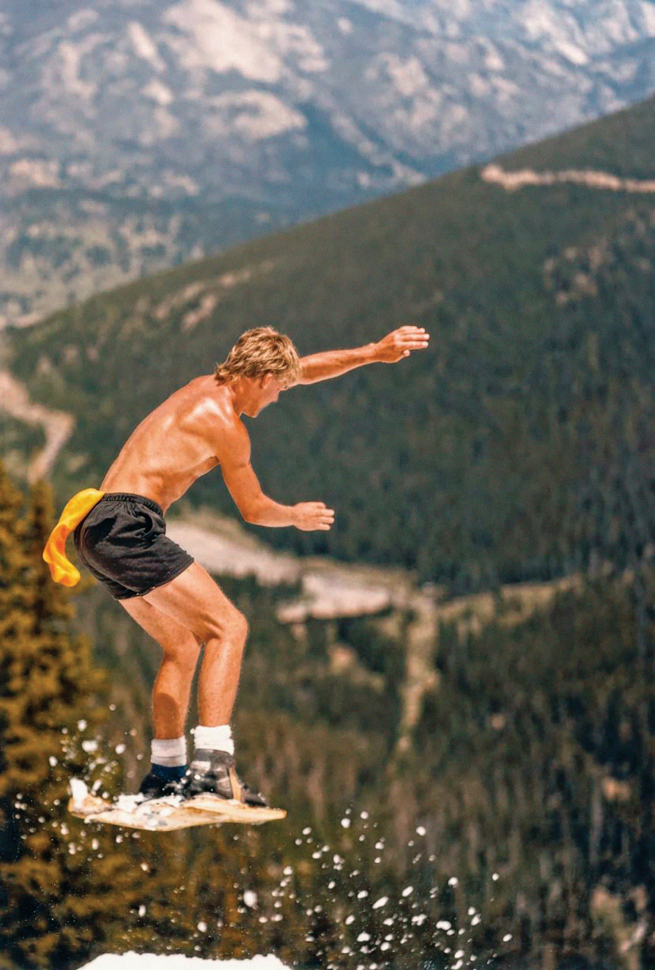
Tim Canaday: It would have been around 1980 or ’82. My very first run was on a Burton Backhill up at Berthoud Pass, Colorado. My brother Tracey dragged me up there, and I instantly fell in love with it. I was about 16 or 17 at the time.
It was around this time that the seeds for Never Summer were planted when Tracey and Scott started pressing boards under the brand name Swift. How did that take shape?
Tracey and his buddy Scott Rolfs took a look at the boards they’d been riding—the old Burton Backhills—and modified the shapes. Where they were riding up at Berthoud Pass was super steep and the powder was always incredibly deep. That’s why those early Swift boards had heavily setback stances and massive, elongated noses; the boards had to maneuver well on steep pitches.
Back then, they were just using two laminates of quarter-inch Baltic birch plywood. Before they knew anything about actual presses, they would put the glued plywood over a cinder block on the ground, drive a car up onto it, and park it overnight. The next morning, the glue had cured and you had a bent piece of laminated wood. From there, they’d cut out the shapes with a jigsaw, and go ride it.
I understand your early contribution to Swift was bringing in some actual woodshop knowledge. Didn’t you build a two-sided press?
Yeah, I was in a high school woodshop class and told my instructor I wanted to build a snowboard. He showed me how to make a positive and negative mold to sandwich the materials together and bar-clamp it. I showed Tracey and Scott, and they went from there. They made boards for friends and family and eventually got some on consignment at a shop called The Wright Life in Fort Collins. Swift lasted until about ’86.


When did the Never Summer spark ignite?
One night, we were out to dinner with my now father-in-law, Nick. He had been reading about snowboarding blowing up as a new winter sport. Knowing our background with Swift, he sat us down and said, “Hey, do you guys want to see if you can get back into making snowboards?” That conversation evolved into us moving back to Colorado.
We found a factory in Summit County owned by Steve Link, who was building Summit Snowboards. We rented space from him and built our first prototypes within three months. Those first boards we built with Steve were pretty archaic, but he showed us the ropes.
Tracey and I started brainstorming how to make a bulletproof board, because the biggest issue back then was durability. Snowboarding had a massive skateboard influence; kids were bonking logs, hitting rocks, and sliding down stairs. If you stayed on the snow, ABS sidewalls were fine, but because we were snowboarders, we didn’t stay on the snow. When you hit something, the ABS would crack and delaminate.
We contacted a plastic supplier and asked for a chunk of polyethylene to see if we could use it for sidewalls. The first few prototypes delaminated immediately because we didn’t know how to treat the plastic to get it to bond. Once the supplier taught us how to prep it, it changed everything. We’ve used UHMW polyethylene sidewalls on every single board since.


A lot of people might not know that Never Summer came out swinging with your very first line in 1991. You had four boards, two of which were twins (one wide) and two asymmetrical boards. Walk us through that fourth board.
That was the XDO, which stood for 10-Degree Offset (X being the Roman numeral for 10). It was a regular or goofy-specific asymmetrical board where the toe edge was offset ten degrees from the heel edge, featuring a deeper heel-side radius and a bigger kick on the tip for powder. Back then, almost everything in the industry was strictly directional, so offering true twins right out of the gate in ’91 was incredibly progressive.
Fast forward to the late 2000s. Around 2007, Lib Tech’s Skate Banana came out, and K2 re-released the Gyrator with reverse camber. When Never Summer dropped your 2008 line, it felt like almost every board featured reverse camber.
Yeah, we put our four best-selling models into our RC (Rocker Camber) profile. At the time, the Skate Banana was flying off shelves. It was incredibly fun and maneuverable, but the main complaint we heard from retailers and riders was that it didn’t hold an edge at speed because it was completely rockered or flat. We wanted to fix that, so we prototyped a board that was flat/rockered between the feet but transitioned into cambered zones out past the bindings toward the tip and tail. The improvement in edge hold and stability was immediate. We filed for a patent in 2008 and received it in 2010.
Today, you guys have evolved that tech into Triple Camber. How does that work?
We have two main versions under that umbrella. Our Hybrid Triple Camber has a rocker area between the feet, but inside that center rocker section, there is a small pocket of positive camber. Then we have our Recurve Triple Camber, which is a more traditional-feeling camber profile with early-rise tips, but it features that same third camber pocket right in the center.
When you put a Triple Camber board on edge, those inner camber zones create distinct pressure points between your feet on the horizontal plane. It acts like a team—it gives you an extra dimension of edge grip right where you need it most.


Was that something you discovered by accident, or were you intentionally searching for it?
We actually built an early, archaic version of a triple camber board way back in 2010, right after our first Rocker Camber boards. The feedback was good, but we weren’t entirely sure about it, so we left it on the drawing board. Four or five years ago, we brought it back to life, refined the geometry, and got our pro riders on it. Around that time, we did a photoshoot with our rider Nick Larson carving at 30 mph across a frozen lake using a winch. When we posted the photos on social media, everyone called BS and said it was Photoshopped.
A few weeks later, we released the video. When you slow the footage down, you can see the ice spray shooting out from exactly those four distinct contact points. Then people said, “Well, you can’t do that on a heel-side,” so we sent Jess Tennyson out there to do it on her heel edge and prove them wrong. It absolutely works.
To date, how many snowboards do you think you’ve designed?
Oh, it has to be in the hundreds or thousands if you count all the minor tweaks. When you know the “guts” of a board work—like the sidecut geometry and core profile—you keep that foundation intact and just update the visual tip and tail shapes to freshen it up.
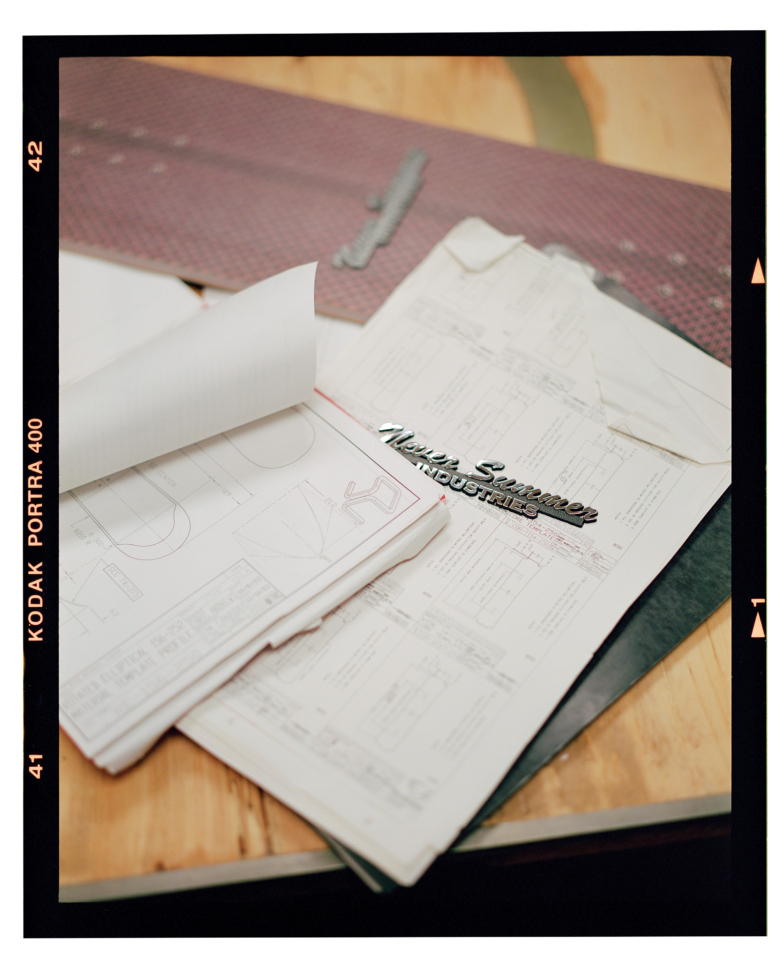
My brother Tracey is a massive part of this process. I’m the one working the AutoCAD software, but he and I put our heads together on every single shape. I’ve personally ridden almost all of them. I’m getting older, so I don’t spend much time in the halfpipe on our freestyle decks anymore, but all-mountain and freeride boards are my absolute jam.
When you’re updating a board or starting completely from scratch, can you already envision exactly how it will ride just by layering the specs in your mind?
Yeah, after 35 years, you develop a strong instinct for how a specific sidecut radius, waist width, and taper profile will interact. But the core flex pattern is what makes or breaks a deck. You can have a beautiful shape, but if the core profiling and hinge points don’t complement the geometry, it won’t perform. I rely heavily on critical feedback, and have a 35-year catalog of our own successes and failures to look back on for inspiration. Plus, our entire factory staff is full of absolute shredders who take immense pride in what they build. They make this whole wheel turn.

Where do you see snowboarding going next? What is on the horizon for Never Summer?
Our big push right now is celebrating the joy of riding fresh corduroy. Everybody wants to chase the perfect powder day, but let’s be real: powder days can be rare, and even when you get one, the fresh snow is usually chopped up by noon. The vast majority of everyday snowboarders spend 95% of their time on groomed trails. We want to show people that every single board in our line is engineered to make those everyday groomer days incredibly fun.
The “Shaper” moniker inside Never Summer used to represent your custom-tuned, uniquely shaped boards. But now, that name has expanded into your other great passion: golf. Tell us about Shaper Golf.
The concept for Shaper Golf came from a deeply personal place for my family. My son fought an incredibly brave 12-year battle with pediatric cancer, and he was an absolute fanatic about golf. He passed away in 2021, but we were out playing together up until about a month before he left us.
Throughout his journey, we met so many incredible people and organizations dedicated to pediatric cancer awareness. After he passed, my wife, my daughter, and I sat down and asked ourselves how we could use our background to give back. We decided to launch a golf apparel line, where a meaningful portion of all proceeds goes directly to three different charity organizations funding pediatric cancer research and family support. It’s a project that is incredibly near and dear to our hearts.
That’s beautiful, Tim. And appropriately enough, we’re sitting here at the golf course right now finishing up a round. You’ve been forced to admire my brutal slice all afternoon.
Hey, it’s not a slice, it’s just a “power fade!” (Laughs) Golf is the ultimate humbling sport. You can think you have it completely figured out on Tuesday and feel like a total beginner again by Wednesday.
Final, toughest question for you: what is your current handicap?
Right now, I’m sitting right at a 10. I know a lot of guys get defensive and dodge that question, but I’m a 10. My old high school woodshop buddy lives down in Arizona now and he plays at a plus-two. It is beautiful and terrifying to watch someone play at that level. Just like snowboarding, when you go out with a crew that is better than you, it pushes you to play harder. Hopefully, I’ll grind my way down into the single digits soon, but dropping from a 10 to a 5 takes a whole lot of golf!
P: Mike Basher