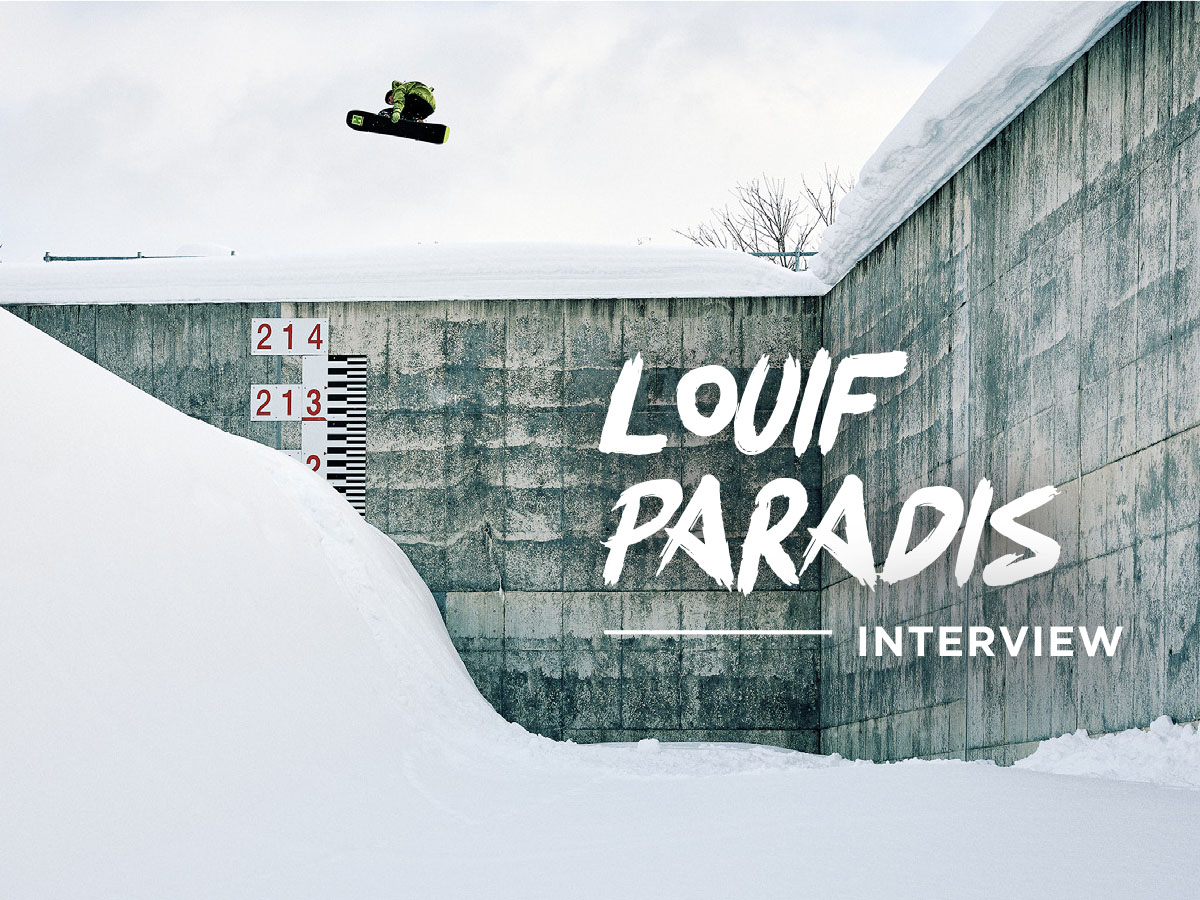
From anchoring the Salomon street team to teaching his young sons how to link turns at his local mountain, Louif Paradis has always brought a calculated, artistic vision to everything he rides. As his career continues to evolve, Louif’s focus is shifting toward longevity, creativity, and finding balance in a year-round cycle of flow.
Mike Basher: It sounds like you had a pretty active summer cruising around Northeast Canada. What have you and the family been up to?
Louif Paradis: Yeah, we took two trips up that way. As soon as the kids finished school, we headed to the Gaspésie Peninsula in Quebec to tour bike trails, hang on the coast, and explore. Then we came back for a couple of weeks of work before taking off to Nova Scotia for three weeks. Just surfing, biking, and hiking around. We really love it out there.
You mentioned your local resort is starting up a bike park next summer?
Yeah, Le Relais is my local hill—it’s actually where I took my first snowboarding lessons. It’s less than ten minutes from my house and right by my kids’ school. It’s where we taught our boys to ride and where we go as a family.
They’re adding a bike park next summer, and I’ve been helping with some of the trail building. Having chairlift-accessed gravity riding right there is going to be amazing, especially for the kids. I love pedalling, but lift access will be pretty cool.
As a lifelong snowboarder, what has it been like experiencing snowboarding through your kids’ eyes?
It’s been really fun to revisit my own foundation—getting back to the absolute basics. You have to dig inside yourself to remember how you learned. You take so many techniques and board-control skills for granted after riding your whole life. You think, “Oh, we can go do this run,” but then you realize holding an edge is actually really hard when you’re just starting out.
When it clicks and you’re following your kid while they link turns right in front of you, it’s super rewarding. My boys are 5 and 7 now. The 5-year-old just started connecting turns last winter, and is learning quickly, I think because he’s chasing his older brother.
Right now, I’m not pushing freestyle or park riding on them at all. They’re not even really into it yet. I just want them to get really good at turning, controlling their board, and have fun. If they want to go into the park later, cool—but if they just want to rip, I’m all for it.
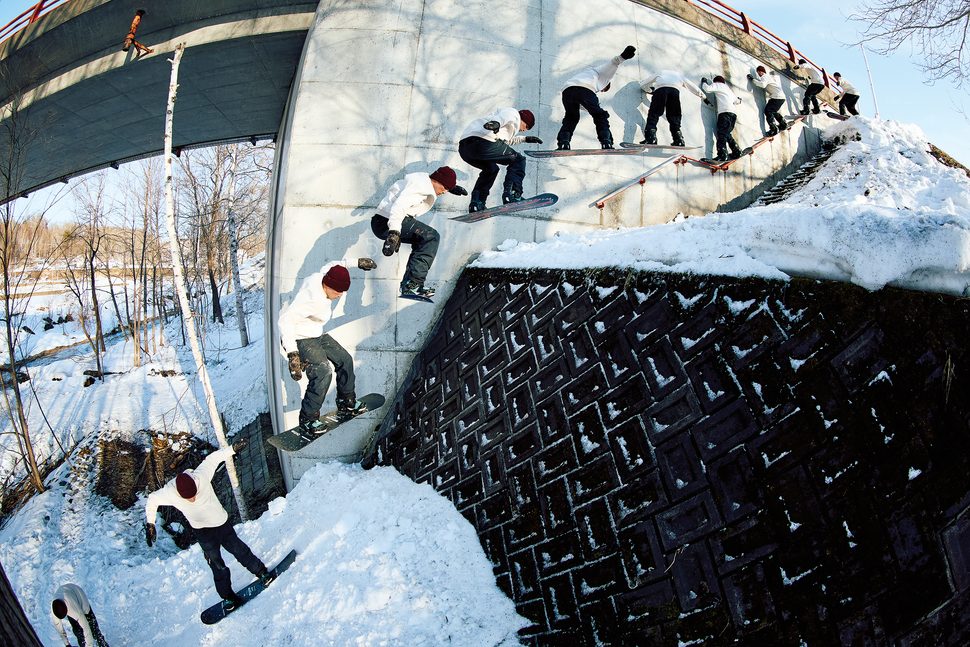
Speaking of doing your own thing, looking at your career, your snowboarding is very calculated, but incredibly creative. How do you balance that structured approach with a creative eye for spots?
I think my creativity comes out in how I read terrain and choose spots rather than pure improvisation. Some riders—like Jed [Anderson] or Forest [Bailey]—can just show up, improvise, and just make it happen. I’m a bit less spontaneous. I find a unique spot or structure, visualize how I want to ride it, and then meticulously prepare it.
Do you usually start with a specific trick in mind and hunt for a spot, or do you find a spot first and let it dictate the trick?
Usually, I’m looking around a city or wherever we’re traveling, finding an interesting structure, and asking, “How can I ride this?” From there, you visualize the trick and discuss possibilities with the filmer—taking angles into account, like making sure the trick faces the lens rather than showing your back the whole time.
I do keep a note on my phone with trick ideas, but I rarely find the exact spot that fits them. I think it’s a good exercise, though, because sometimes I can manifest something.
Send us a screen shot!
It would be pretty funny. Then blur it out, so nobody steals it!
What kind of ideas are on that list?
Some are pretty funky. One says “backside 180, reverse 180 to 50/50”. I don’t even understand what I meant by that. I also have “switch backside wall ride” and “nosepress on a wall”. I’ve had an idea for an upside down 50-50 for about 15 years. The original spot I wanted to do it on got torn down before I could ride it, so I’ve been looking for a similar spot ever since.
I just like doing things we haven’t seen in a long time—or ever. I don’t like repeating myself or feeling like I’m doing the same thing over and over. Spot and trick selection are where I push myself to go left and right instead of straight to what others are doing.
Who’s your dream team on a filming trip?
Recently, traveling with Finn [Westbury] and Tommy [Gesme] has been incredible. Finn is hyperactive and multitasking 24/7—he’s super positive all the time. Tommy has so much street experience, spot-finding knowledge, and street-smart efficiency.
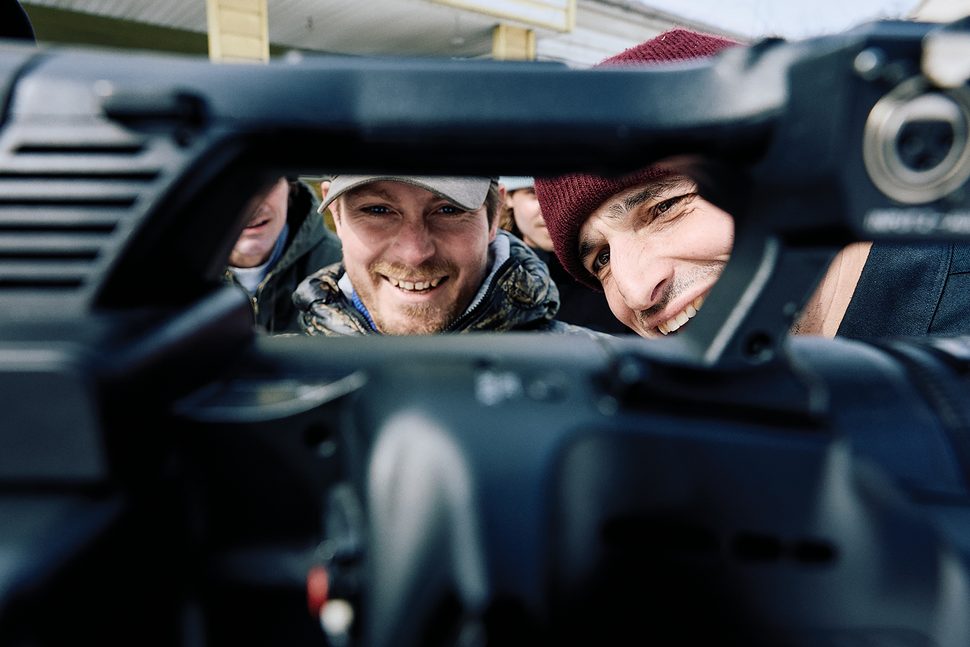
Working with filmer Bryden Bowley has been awesome too. I started working with him three years ago on My Clay Angel. He’s open-minded, detail-oriented, and super creative. It’s really fun to bounce ideas back and forth with him.
Joseph Roby has to be there as well. He lightens up the mood, and is a solid photographer. It’s been awesome seeing his evolution. He’s crushing it.
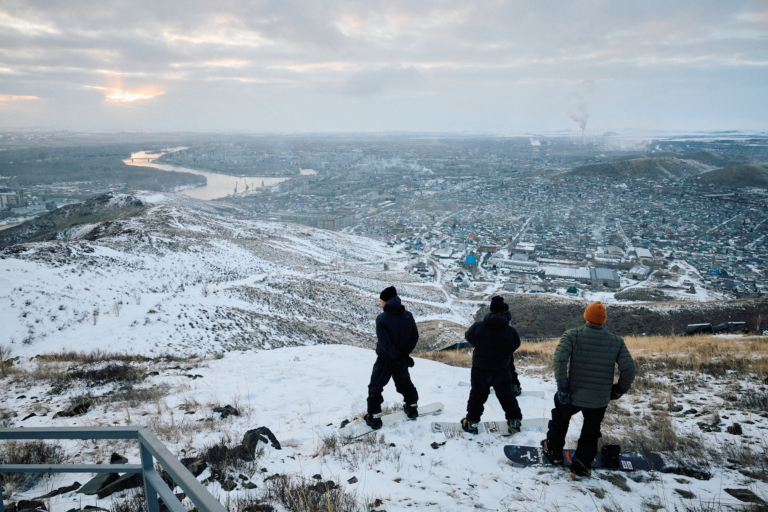
You guys went to Kazakhstan for this new film project, right? How was that experience?
Yeah! Bryden was super keen on doing an exotic trip to add distinct color and culture to the film. Kazakhstan was great. The snow conditions were harsh at times, and people seemed a bit reserved at first, but everyone turned out to be incredibly warm, welcoming, and eager to share their culture with us. Bryden was amazed the entire time, which added to the energy of the trip.
What is your role within the Salomon team crew on these projects?
As the most experienced rider in this specific film crew, I try to lead by example. My main goal is to be the optimistic guy who works hard, wakes up at 5:00 AM if we have to, MacGyvers a spot when we need to get creative, and makes sure everyone finishes the day with a clip they’re proud of. I try not to dominate decision-making, and go with the flow of my crew. I sometimes step back and see where the younger guys want to go, because if I always take the lead, we might miss good opportunities I wouldn’t have thought of.
What’s the title of this upcoming movie project?
Shiver Creek.
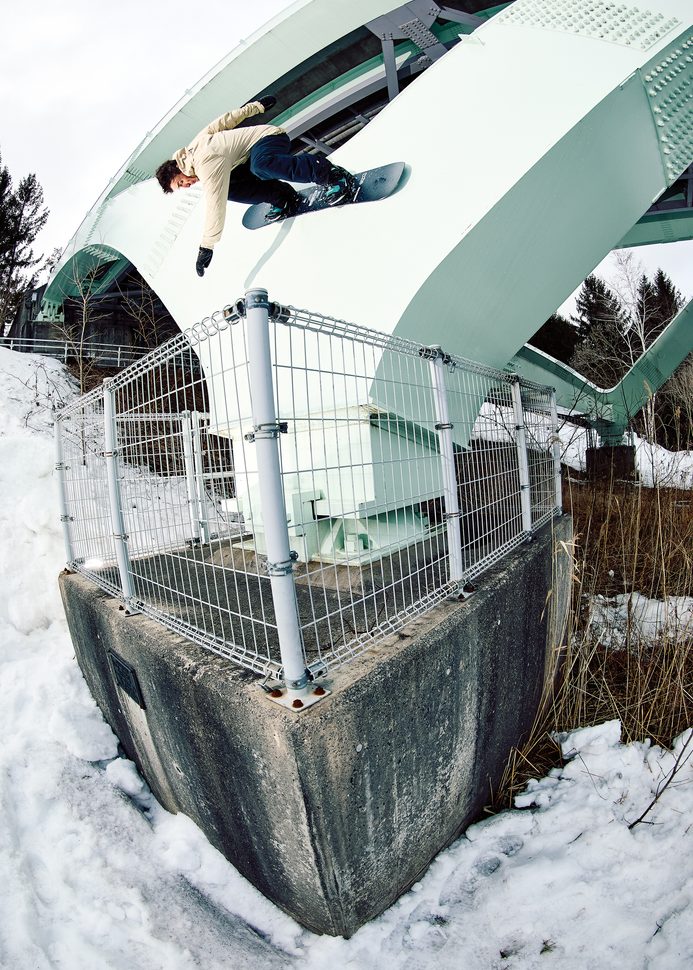
We’ve gotten our hands on some hammer shots from your season. Walk us through where you traveled, what stood out, and what you felt most accomplished about.
We kicked off the season in January with a classic trip to Japan. In February, I joined a crew in Pittsburgh—it was actually my first time ever going there. After hearing about how good the street riding was for so many years, being there made me think, “Why didn’t I come here sooner?” In my 15- to 20-year career, I know there were winters with snow there that I just missed. Pittsburgh is a crazy city with tons of history—old steel, run-down spots, and unique architectural terrain everywhere. It was a cool “better late than never” moment.
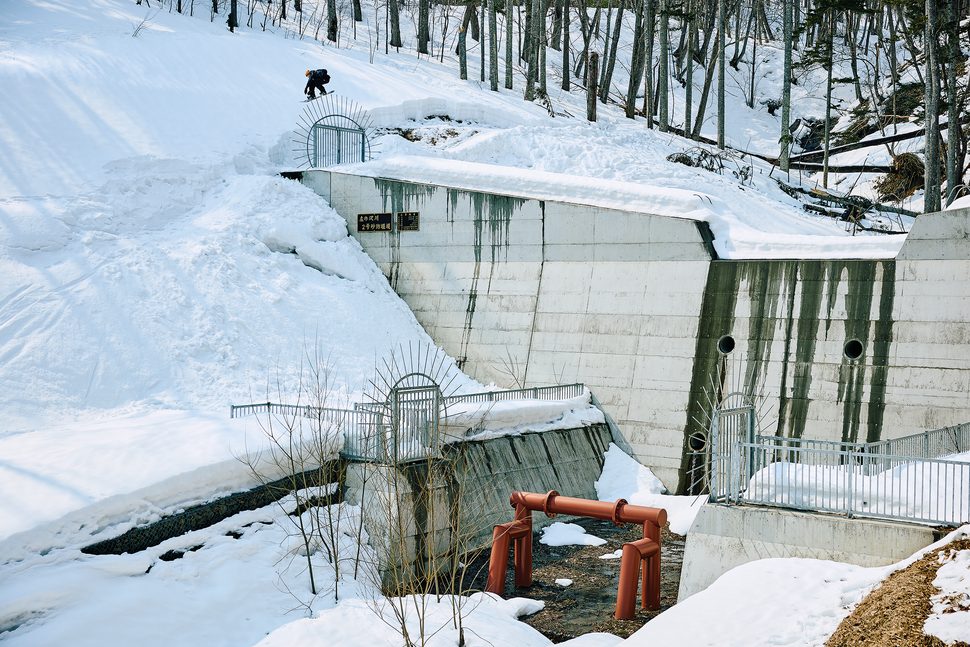
After that, I went back home before heading back to Japan for round two in March. Hokkaido in March is beautiful—the days are longer and temperatures are a bit milder. You still don’t know if you’re gonna get a freak storm, but in general it’s more spring-like. We decided to explore some more remote areas of the island. I finally checked off several spots in lesser-known towns that I had pinned on Google Earth for years.
How would you describe the overall flavor or focus of your riding this past season?
A bit of sidecountry powder in Japan and then it was very classic street riding. I didn’t get to do as many out-of-the-box or hyper-creative things as I would have liked, but it was fun to go back to my street roots—hitting down-rails, and playing in that classic urban environment. A lot of that comes down to snow depth. If you have three feet of snow in a city, you can jump from building to building. When you only have a foot, you stay a bit more grounded and down-to-earth.


You grew up in Quebec City, which became an absolute epicenter for progressive urban snowboarding in the mid-2000s—spots like the Red Ledge and iconic rails all over town. What was it like being there as a young rider when the heavy crews started showing up?
It was an interesting dynamic. By the time guys like Mikey [LeBlanc], Justin [Bennee], and [Jon] Kooley started coming to Quebec, my friends and I were already out there riding and scouting those spots every day.
We looked up to those dudes immensely—Bennee’s cab 270 on the Battlefield rail is still, to this day, the best cab 270 ever done. But at the same time, we weren’t just starstruck kids sitting on the sidelines. We wanted to session with them and show them what we could do. We wanted to play in their league.
That local scene produced an unbelievable amount of talent. Who was in your crew?
I was with LNP, Ben Bilocq, Nic Sauvé, Frank April, Phil Jacques, Max Baillargeon, Will Lavigne and Alex Cantin–all amazing riders who made it as pro snowboarders. It was special. If I had grown up as a solo rider or only had one other friend riding street, I don’t think I ever would have made it to where I am today.
We were just a pack of young kids watching videos like Shakedown, and Love/Hate, studying what was happening in Salt Lake, Minnesota, and Scandinavia. Then we realized, “Wait, we have incredible spots just like these.”
When guys in our immediate crew started getting picked up—like LNP with Rome, or Nic Sauvé on Forum—it made the dream a reality. It wasn’t some far-fetched fantasy anymore. That group force pushed every single one of us.
As your career evolves and matures, has what you want to get into and what you’re OK to get into as far as spot selection changed?
I’m starting to acknowledge physical limitations—risk tolerance and the sheer impact my body can take. Landing flat doesn’t feel good on the knees anymore, so focusing on hitting transitions is key, and repeated impact when trying a trick over and over takes its toll. I would much rather hit a bigger feature and fully commit a few times versus trying a tech trick on a smaller feature 100 times.
Looking forward, I would like to lean further into the artistic, creative side of snowboarding. After spending so many years searching for existing street spots, I’m starting to get more excited about creating my own—shaping features with tools, or repurposed materials. Some of those dream tricks or spots can happen a lot faster if you just build the right setup yourself.
It would be interesting to do it while filming for a project with a filmer and friends, but yeah I also picture it being cool in a community diy park, in actual resorts or maybe for an event too.
You have a pretty famous backyard setup at your house in Quebec once winter hits. How does that affect your seasonal routine?
Having that setup right outside my door is incredible. As soon as we get enough snow, late November or early December, I set up a line with 2 or 3 rails, and pretty quickly we get enough to have four rails in a row. It has really good flow, with a quick rhythm, and you have to land perfectly to keep speed for the next. It really sharpens your board control to get ready for the winter. To get that kind of rush right within your own living space is a unique feeling.
As your boys get older, do you see that backyard space evolving for them?
Absolutely. As they get better at riding, I want to move dirt, reshape the terrain, and turn it into a hybrid setup—something that challenges me, but is super fun and approachable for them too. It’s actually gonna become theirs more than mine. Hopefully they see the fun in the building side of it too.
You seem to be trailblazing your way in life, and you’ve said the word “flow” a few times in our conversation. Is that like your mantra?
I wouldn’t say that it’s my mantra but it certainly is something that I’m after and what feels best to me, on a board, on a bike but also just in life in general. Not much beats feeling weightless and being fully focused in the present. I sense it the most while riding my powsurf in the woods behind my house. The moment that I step onto the board and start moving, I get a buzzing feeling inside and it’s addictive. On a bike it starts the minute you hop on it and start pedalling until you roll back into the garage. On a snowboard, I get that feeling on a long run with friends but also when I yell “drop in” to the filmer.
It’s a year round cycle: riding and powsurfing, building and shaping, creating and visualizing. I want to keep doing what feels good to myself and my family; staying healthy and active and continuing to do rad things with them. I just have to keep going with my gut.